University of Minnesota
Driven to Discover


CEHD Wordmark - Print Version

College of Education and Human Development
104 Burton Hall
178 Pillsbury Dr. S.E
Minneapolis, MN 55455
Voice:  612-626-9252

Download the current issue of Connect as a PDF

Mind Matters

Married researchers connect the line from brain function to science and math learning

By Greg Breinning | Summer 2010

Is it possible to tell who will make a great scientist based on some simple tests that reveal how the brain works? Or even to predict by scanning brain activity with an MRI?

Possibly, but not yet. First, an introduction to the people who are researching these concepts:

Keisha and Sashank Varma are married, both work as assistant professors in the Department of Educational Psychology, and both study how human minds grapple with the unfamiliar and often abstract problems posed by science and mathematics. But they approach the question in vastly different ways.

Keisha’s work is more traditional and more practical: understanding cognitive processes that underlie scientific learning and how students might learn better using computing technology. She measures how well students grasp scientific lessons through traditional research approaches such as testing.

Sashank approaches the process more fundamentally, by using technology to peer into the brain to understand the architecture of the cortex, which enables the complex mental tasks that he describes as distinctly human “and indeed make us human.”

Despite similarities in their scholarship, they only recently began working together for the very first time. “It’s the only thing we’ve ever collaborated on in almost 20 years of knowing each other,” says Sashank.

Speaking professionally, of course.

New approaches to science

The Varmas met as doctoral students at Vanderbilt University. When Keisha finished her degree, she moved to the University of California, Berkeley, and Sashank soon followed. There, Marcia Linn was developing WISE (Web-based Inquiry Science Environment), a computer-based curriculum that teaches science subjects through explanations, narratives, graphics, animation, and guided discussions.

Keisha had long been interested in how the mind organizes information, whether everyday narratives or scientific processes of proposing and testing hypotheses. She was also interested in using technology to help students learn. “It started with students who couldn’t comprehend stories well,” she says. “They were at risk for failing school.”

  • Keisha

    Keisha investigates how a computer module helps students learn abstract scientific concepts through an inquiry-based approach.

Science topics are even more difficult for many kids, Keisha says. Concepts and problems are often presented in expository fashion, rather than the kind of narratives students may be accustomed to. Many are being asked for the first time to generate questions and to gather and evaluate evidence. “I think doing those things in order to learn is new to young students,” she says.

At Berkeley, her interest shifted from the psychology of cognition to science education as she helped design online learning programs. The researchers were discovering that a computer-enhanced curriculum, like WISE, did indeed help students learn better.

Keisha’s research examined teacher factors that contributed to improved utilization of the learning technology. She discovered that previous experience with the program helps. So does the presence of another teacher in the school who is using the curriculum and can share experiences.

Since the Varmas moved to Minnesota two years ago, Keisha has been helping science teachers at Richfield Middle School add the WISE program to their own curriculum.

“The students get real excited about the project,” says Gary Aylward (B.S. ’88, M.Ed. ’05), head of the Science Department at Richfield Middle School, who has worked with computer-based instruction for 15 years. “This is far and away the best computer-based interactive project that I have ever worked on. Students are seeing different visualizations and models which represent the concepts that we’re trying to have them understand in the classroom. There’s always a hands-on lab. They relate that back to the broader concept that they’re learning.”

Keisha is convinced technology like WISE can help all students—not just because of the visualizations and inquiry prompts in the program itself, but also because students are working two to a computer. “They’re working in pairs. And it allows each student to show their strengths in different ways,” she says.

Learning outcomes from inquiry-based teaching—as opposed to memorizing principles and formulas—can be challenging to assess. Are students grasping the process of scientific inquiry? To find out, teachers “ask lots of open-ended questions of students to get them to continually express their ideas,” Keisha explains. “The teachers need to figure out how to grade or assess that learning—to get a picture of what students know.”

Keisha developed the global warming module of WISE, which she has modified based on student learning data and feedback from teachers. She continues to investigate two questions associated with the curriculum’s use. The first is how learning differs between a hands-on experience, such as a traditional laboratory experiment, and a computer-based visualization. The second relates to executive function and the project she is working on with Sashank.

It starts with the brain

To understand how the mind comprehends abstract problems, Sashank Varma turns to the lab.

As an undergraduate in mathematics and cognitive science at Carnegie Mellon, and later as a graduate student at Vanderbilt University, he worked with Marcel Just to devise 4CAPS, a computer model of how various areas of the brain collaborate. The model even accounts for how areas of the brain, viewed by magnetic resonance imaging (MRI), activate during tasks such as sentence comprehension, spatial reasoning, problem solving, and dual tasking. During his post-doctoral work at UC, Berkeley, Sashank researched how adults and children understand simple, yet abstract, mathematical concepts such as negative numbers. He also plumbed how the mind understands stories and grammatical constructions—“not so much about learning, but simply thinking.”

Before researchers make the beguiling MRI images that suggest an objective understanding of brain function, they must know where to look in the brain and what the neural activity means. “You have to do the psychological work first before you do the imaging work,” Sashank explains.

And this is why neuroscientists and educators have a lot to teach each other, he says. “Neuroscientists have these amazing tools. But the questions they ask are often not so interesting or informative for education,” says Sashank. “They’re often questions about very low-level cognitive abilities such as attention or vision. We still know very little about the neuroscience of high-level cognitive thinking, the kinds of things that make us human, like understanding stories or proving mathematical theorems. We know very little, almost nothing, about how the brain does that.”

That’s where education comes in. Educators know a lot about the progression of learning to produce narrative text or write geometric proofs. In other words, they know a lot about how learning develops. “By themselves neuroscientists haven’t yet come up with interesting insights about those kinds of complex cognitive functions,” Sashank says.

So the Varmas are tackling an interesting question together: How is scientific reasoning related to working memory and executive function? Executive function involves planning to achieve goals, resolving conflicts, selecting alternatives, and shifting from hypotheses that aren’t working to new hypotheses that may. Working memory is the ability to store and process information.

“These are very basic cognitive functions we know are situated in the frontal lobe,” says Sashank. “A lot of these functions seem important to the kinds of scientific reasoning that Keisha looks at.”

  • Sashank

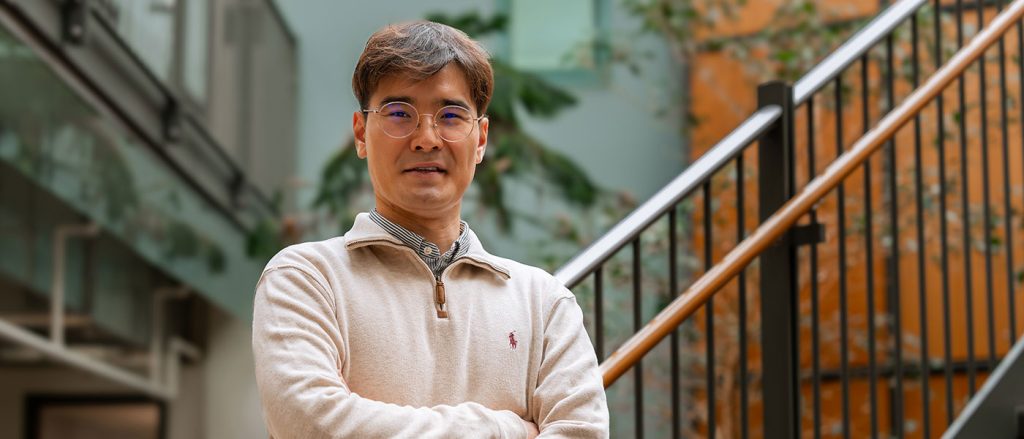
    Sashank, shown outside of his office in the Department of Educational Psychology, will trace how student ability to learn science via Keisha’s computerized approach maps with cognitive measures.

Can simple tests of these skills evaluate a student’s aptitude and potential for science? And somewhere down the line, can imaging reveal the brain functions that underpin scientific reasoning?

The frontal lobe develops late, in early adolescence. So some middle-school students will be far along, some will have barely begun, and some presumably will never excel at these tasks. Keisha is now collecting data on how well students fare in scientific reasoning through use of the WISE module. Meanwhile, Sashank is adapting for the classroom standard tests to measure executive function and working memory, such as manipulating colored balls, sorting cards with colored symbols, and remembering sequences of numbers.

The next step will be to see which executive functions predict science success, says Sashank. “Who’s going to be able to design solid experiments? Who’s going to be able to reason from evidence?”

Students will complete two WISE modules. They will be tested on what they learned and their abilities in scientific reasoning. Then they’ll be tested again, this time for executive function and working memory.

“What’s kind of cool about our work is tying these frontal lobe functions to classroom-based learning,” says Keisha.

Could such knowledge actually help kids learn? Sashank says some research has suggested people can train to improve executive function and boost their abilities in many tasks.

So far, all of this is speculative. But understanding how the brain grapples with scientific process could help teachers and researchers in the classroom confirm what they believe they understand about learning. In the future the Varmas’ research may expand to imaging of the brain to assess how brain function changes following computer-based science instruction.

Says Sashank, “I think it’s nice to know that one’s constructs have a basis in the brain.”


This article first appeared in Connect, the magazine of the College of Education and Human Development.
Read the magazine, stay in touch, and sign up for alerts at: cehd.umn.edu/Connect

College of Education and Human Development | External Relations
|  612-626-8782 | 105 Burton Hall, 178 Pillsbury Dr. S.E. Minneapolis, MN 55455

© 2012 Regents of the University of Minnesota. All rights reserved.
The University of Minnesota is an equal opportunity educator and employer.
Revised April 11, 2012